Roger Pullin
The Substance Dualistic Self,
One Whole Reality and
the Writ of Mathematics
A substance dualistic model of the human self is proposed, bridging the one whole reality of the material and spiritual realms and with the writ of mathematics running throughout. Unlike classical Cartesian dualism, the proposed model has an entirely physical and physically-derived body-mind, including the entire composition and workings of the brain, and an entirely spiritual soul, which is always in the spiritual realm. Body-mind and soul connect via the mind-soul interface. Body-mind reasoning about material realm information combines with soul processing of spiritual realm information in some common format, possibly quantum probability fields. This uniquely human capacity, termed Free Thought, enables conscious, free-willed and private choices about higher things including beliefs, creativity and all matters of conscience. Material needs such as food and shelter are assessed by basic thought. Free Thought considers any moral issues in their pursuit. Implications of this model are discussed for faith and religions, science and human relations.
Introduction
This paper proposes a substance dualistic model of the human self that provides for conscious, free-willed and private choices about the higher things of life, including faith and unbelief (where faith is defined as belief and trust in God), creativity in the arts and sciences and all matters of conscience. Human consciousness can be defined as the capacity to receive, process and respond to information from the material and spiritual realms. In the terminology used throughout this paper, human consciousness is the totality of the self’s basic thought based on sensing material surroundings and securing material needs such as food and shelter through mental reasoning, and the self’s Free Thought about higher things, including beliefs, creativity, ethics and all matters of conscience, through combining mental reasoning with the processing of spiritual information in the soul. This paper refers only to the human condition and excludes any consideration of whether other past or present life-forms have souls and the capacity for Free Thought about higher things. The present author’s position is that Homo sapiens is the only extant life-form that is ensouled and capable of Free Thought as defined here. Free Thought operates through conscious free will.
Conscious free will in humans has been described as illusory (e.g., Wegner 2002). Some who deny free will point to the findings of Benjamin Libet and colleagues that brain electrical activity in an actor begins before a conscious intention to act can be reported. But Libet also wrote: “Human subjects became aware of intention to act 350-400 ms after RP (Readiness Potential) starts, but 200 ms before the motor act. The volitional process is therefore initiated (original author’s emphases) unconsciously. But the conscious function could still control the outcome; it can veto the act. Free will is therefore not excluded (present author’s emphasis) (Libet 1999, p.47).”
The reported lag between the immediacy of a single electrical measurement and the time taken for the brain to package a reportable message is not surprising. Moreover, research on simple motor acts is an unlikely guide to freedom of choice about higher things. In the present paper, free will is taken as a given and is defined as the sovereign state of selfhood from which all human thought proceeds.
Believers typically envisage God and/or other spiritual beings as inhabiting a spiritual realm and capable of intervening in the material realm to various extents, directly and/or through human agents. God is defined here as Creator of the wherewithal for everything else, material and spiritual, that has ever existed, exists now and can ever exist. God is assumed to act only for the good of creation while opposed by the spiritual force for evil, which seeks only to harm. The present author holds to these positions.
Nonbelievers typically regard all that ever was, is now and can ever be as physical and physically-derived; i.e., the material realm, also called the universe or multiverse. The material realm is defined here as all that has ever existed, exists now and can ever exist within time and space, composed of and derived from matter and energy. The spiritual realm is defined as all that has ever existed, exists now and can ever exist beyond the material realm, being entirely spiritual in substance and having no physical ontology.
Many believers and nonbelievers, across religions, atheism, agnosticism and science, recognize one whole reality in which all that ever was, is now and can ever be is interconnected and/or interconnectable. The one whole reality includes all that humans can experience, imagine and construct, as well as everything else that exists but is inaccessible in the prevailing human condition. The human self poses questions to the one whole reality and is answered with material and/or spiritual information, in body-mind and/or soul. Outcomes of the processing of this information shift body-mind and/or soul baselines, pending more questions. The past is done. The future is open.
The one whole reality can be conceived as made of one or more substances, or as a complex and dynamic compendium of information without the need to recognize enduring substances, or as a combination of both. The term dualism is used in this paper only in the sense of substance dualism. Substances are defined here as members of exclusive sets of ingredients, having the same ontology at all levels of complexity. Substance monism regards reality as entirely physical and physically-derived. Substance dualism recognizes in addition the spiritual realm with spiritual entities, states and processes. The writ of mathematics means the capacity of mathematics to encode for all possible and impossible entities, processes and states.
Scripture attests that God made humans “in our (i.e., God’s) image (Genesis 1:26 KJV).” For Christians, “That which is born of the flesh is flesh; and that which is born of the Spirit is spirit (John 3:6 KJV) and “God is a Spirit (John 4:24 KJV).” To connect with the divine (God) or the diabolic (the spiritual force for evil) a human self must receive, process and respond to spiritual information. All of the above statements and requirements suggest a spiritual component in the human self, which is the present author’s position.
Modeling the human self is faced with a confusing terminology for mind and soul. The biblical Greek pneuma and psyche, Latin spiritus, Hebrew nephesh (mind or soul) and ruach (breath or spirit) and the Qur’an’s ‘Aql (intellect), Nafs (soul), Qalb (heart) and Ruh (spirit) (Javairia and Khan 2014, p.123) are all in the mix. Descartes and his followers used terms for mind and soul interchangeably, such that: “Esprit and âme, mentis and anima, mind and soul: all were one (Makari 2015, p.28).”
Classical Cartesian substance dualism has modeled the human self as a material body and a separate nonmaterial (mental or mental-cum-spiritual) mind or mind-cum-soul and has been widely rejected, mainly because it lacks a material-nonmaterial interface. Antonio Damasio summarized “Descartes’ error” as “the abyssal separation between body and mind…the separation of the most refined operations of mind from the structure and function of a biological organism (Damasio 1994, pp.249-250).”
Roger Pullin proposed an entirely physical and physically-derived body-mind and an entirely spiritual soul, with body-mind and soul interacting via the mind-soul interface (Pullin 2014, pp.88-93). The body-mind is the totality of the physical and physically-derived human self, including the entire composition and workings of the brain. The soul is the human self’s spiritual component and is always in the spiritual realm, prior to and during temporal life and after death. The soul as such has no physical location or scale and is immune from physical deterioration and damage. The mind-soul interface is the portal through which the results of mental reasoning about material realm information and soul processing of spiritual realm information can combine in some common format, thereby enabling Free Thought. This paper develops the case for this model, hereinafter called the proposed model.
The proposed model makes no use of the concepts of embodiment, emergence and transcendence, which are often used to suggest how something physical can contain or yield something beyond the physical by becoming sufficiently complex. This affords no escapes from physical ontology. For example, Keith Ward gave the soul the “capacity for transcendence” and “capacity to ‘exist’, to stand outside the physical processes that generate it and of which it is part” and stated: “…the soul is both a spiritual and an embodied reality. It is not a ghost behind the scenes, and it is not just the physical brain…It is a point of subjectivity and transcendence, of rational understanding and responsible action, which comes to be at a particular stage of the emergent interactions of spatial, material substances.” (Ward 1998, pp.142,148).”
The present paper accords physical ontology to the entire composition and workings of the body-mind and spiritual ontology to the soul. It commences by noting the broad consensus to recognize one whole reality and making the case that the writ of mathematics runs throughout the material and spiritual realms. Brief reviews follow of recent support for substance monism and substance dualism. The proposed model is then presented and discussed. The paper concludes with discussions of some implications of the proposed model for faith and religions, science and human relations.
The One Whole Reality
Across Eastern and Western philosophy, religions and science there has long been a consensus to conceive reality as one interconnected whole, but with many diverse opinions about its likely composition and workings. Some opinions are based on objective evidence from science. Others are based on subjective evidence from personal experiences, including mystical and religious experiences that are taken as interactions with the spiritual realm. For some, subjective evidence attained through faith complements objective evidence from science. For example, the Society of Ordained Scientists prays daily to the “Creator and Redeemer of all that is, source and foundation of time and space, matter and energy, life and consciousness (www.ordsci.org).”
Fritjof Capra described being at one with the one whole reality as “engaged in a gigantic cosmic dance (Capra 1977, p.xv)” and summarized the one whole reality as: “the awareness of the unity and mutual interrelation of all things and events, the experience of all phenomena in the world as manifestations of a basic oneness (Capra 1977, p.117).” Frederico Faggin had a similar experience, which he described as “knowing that the world is made of a ‘substance’ that feels like love and I am that” and defined the “One” as “The totality of what exists, both in potentiality and in actuality (original author’s emphasis) (Faggin 2024, pp.10, 305)”.
According to Carlo Rovelli: “The world is made up of particles + fields, and nothing else; there is no need to add space as an extra ingredient. Newton’s space is the gravitational field (original author’s emphasis) (Rovelli 2017, p.65)”. Frank Wilczek stated: “Fields rule. Quantum fields, that is…From forces we are led to fields, and from (quantum) fields, we are led to particles. From particles we are led to (quantum) fields, and from fields, we are led to forces. Thus, we come to understand that substance and force are two aspects of a common underlying reality (Wilczek 2021, p.102).”
David Bohm envisaged “a new notion of order that maybe appropriate to a universe of unbroken wholeness…the implicate or enfolded order (original author’s emphasis)” and proposed that: “…consciousness (which we take to include thought, feeling, desire, will etc.) is to be comprehended in terms of the implicate order, along with reality as a whole (Bohm 2002, p.249).” Bohm sought a common ground for the one whole reality but suggested, as follows, that delving ever deeper would not reveal the complete picture: “In our proposed views concerning the general nature of ‘the totality of all that is’ we regard even this ground as a mere stage, in the sense that there could in principle be an infinity of development beyond it (Bohm 2002, p.270).”
Roger Penrose modeled reality as three interconnected “worlds”: “the Platonic mathematical, the physical and the mental” (Penrose 2004, p.18, Figure 1.3).” Recognizing that this might represent “too hard-boiled a scientific attitude”, Penrose envisaged possible open-ended extensions from all three worlds, to provide for: 1. “the possibility of physical action beyond mathematical control”; 2. “the belief that there might be mentality that is not rooted in physical structures”; 3. “the existence of true mathematical assertions whose truth is in principle inaccessible to reason and insight (Penrose 2004, pp.19-20; Figure 1.4).” Penrose has described the Platonic mathematical world as having “its own timeless and locationless existence, while allowing it to be accessible to us through mental activity” and has summarized his model as: “three different kinds of reality, with something (as yet) profoundly mysterious in the relations between the three (Penrose 2025, p.11).”
Vlatko Vedral saw the whole universe as quantum information and stated: “…information is the underlying thread that connects all phenomena we see around us as well as explaining their origin. Our reality is ultimately made up of information (Vedral 2010, p.13).” The proposed model assumes that this applies to the one whole reality of the material and spiritual realms, as accessible to the human self. Quantum probability fields might then be a common format for the sharing of information between body-mind and soul.
The Writ of Mathematics
Kurt Gödel showed the essential incompleteness of mathematics, but mathematics really does encode for and is expressed in whatever is seen as possible and impossible, in nature and in human experiences and imagination. Mathematical explorations can describe other possible universes beyond the observable one. Mathematics indicated the necessary existence of the Higgs boson before it was shown to exist.
Mathematics works in the same way for everyone and is reliable, as expressed in Eugene Wigner’s much quoted phrase “the unreasonable effectiveness of mathematics (Wigner 1960).” As recounted by Garrett Graff, Wigner with John Wheeler and others solved the problem of reduced neutron flux in a nuclear reactor during development of the first atomic bomb. Calculations showed that iodine, a radioactive fission product, was decaying into xenon-135, which was halting the chain reaction (Graff 2025, p.239).
The writ of mathematics clearly runs throughout the material realm. Mathematics is applied whenever anything is quantified by counting or measurement. Mathematics is the language of physics from quantum mechanics to cosmology, of chemical structures and reactions, and of genotypes and their phenotypic expressions. The Fibonacci sequence (1, 1, 2, 3, 5, 8, 13…) and the Golden Ratio (1.618, which is approached by dividing any number above 5 in that sequence by its predecessor) are found widely in nature; for example, in plant structures optimizing light reception and seed storage etc., and in the strong spiral structures of animals, such as the nautilus. Adrian Bejan (2009) related vision, cognition and locomotion to the Golden Ratio throughout nature.
The same mathematics might or might not apply in the spiritual realm, which is envisaged here as having no time and space, matter and energy, gravity etc., but the quantification of anything spiritual, by counting or measurement, would be an application of mathematics. Scripture, also called Holy Writ, contains many mathematical descriptions of the spiritual realm; for example, in the Book of Revelation. For the purposes of this paper, the writ of mathematics is envisaged as running throughout both realms, under God.
The search for a Theory of Everything is primarily mathematical. Mir Faizal and co-authors, based on the limits that Gödel’s and other incompleteness theorems place on any “totally algorithmic ‘Theory of Everything’”, concluded that: “neither ‘its’ nor ‘bits’ may be sufficient to define reality. Rather, a deeper description expressed not in terms of information but in terms of non-algorithmic understanding is required for a complete and consistent theory of everything (Faizal et al. 2025, p.15)”.
A complete and consistent Theory of Everything seems unattainable, but the all-pervasive writ of mathematics and the processing and understanding of all accessible information will take us as far as is possible, spanning the material and spiritual realms.
Substance Monism
Substance monism is a complex topic with a wide diversity of models. The following examples were chosen to illustrate how some substance monists, including believers, reject substance dualism while still attesting to the spiritual nature of God and the truth of God-human interactions. Their models appear to illustrate what Sarah Lane Ritchie has called “intuitive dualism” (Ritchie 2019, p.132). Extensive quotes are used here to illustrate the main aspects of some of these models. The present author finds them all unconvincing as explanations of the human condition while noting, with all due respect, that their proponents recognize its physical and spiritual aspects.
Some substance monists de-emphasize substances per se. For example, Ian Barbour concluded that: “The dipolar monism and organizational pluralism proposed by process philosophy avoids the shortcomings of both dualism and materialism by postulating events and processes rather than enduring substances or entities (Barbour 2002, p.280).” Neutral monism regards reality as a unified material plus mental system, not as different substances (see Stubenberg and Wishon 2023).
Philip Clayton endorsed “an ontological view…that might be called emergentist monism…(that)…unlike dual-aspect monism, which argues that the mental and the physical are two different ways to characterize the one ‘stuff’…conceives the relationship between them as temporal and hierarchical.” Clayton found here “no justification for the ‘dualism’ label” but accepted that “the theory could fairly be called property pluralism, since it countenances a wide range of properties depending on their position in the complexity hierarchy (Clayton 2002, pp.209, 212).”
Arthur Peacocke also advocated “an emergentist monism” and argued that: “Although ‘information’ is a concept distinct from matter and energy, in actual systems no information flows without some exchange of energy and/or matter (Peacocke 2002, pp. 216, 225).” Peacocke assumed that “God is ‘more than’ the world, which is nevertheless ‘in God’…God sustains everything in existence and is present to all” and proposed a model for interactions between “God and the world (including humanity)”, with humanity “multileveled (Peacocke 2002, pp.237-239).”
Dual-aspect monism has become the most popular substance monistic model among those that allow for wider spiritual contexts. Nicolas Spencer is “firmly in the dual-aspect monist camp” (personal communication to the present author; April 8, 2024).
John Polkinghorne defined dual-aspect monism as follows: “There is only one stuff in the world, (not two – the material and the mental), but it can occur in two contrasting states (material and mental phases, a physicist would say) (Polkinghorne 1996, p.21).” This definition applies to what exists “in the world” and makes no mention of a spiritual realm. Its description of the “one stuff” as “material and mental” resembles the proposed model’s body-mind, which is entirely physical/physically-derived.
Seeing nothing substantially spiritual in the human self, Polkinghorne described his soul as “the almost infinitely complex, dynamic, information-bearing pattern, carried at any instant by the matter of my animated body and continuously developing throughout all the constituent changes of my bodily make-up during the course of my earthly life” (Polkinghorne 1996, p.163)”, and stated that taking him apart would reveal only “a collection of quarks and gluons and electrons (Polkinghorne 1999, p.429).”
Malcolm Jeeves endorsed dual-aspect monism in his 2008 Boyle Lecture and stated: “Today the accumulating evidence from neuropsychology makes it extremely difficult to maintain a view that there are two different substances interacting in the human person (Jeeves 2009a, p.35).” Jeeves’ respondents broadly agreed. Warren Brown emphasized “emergence…(as)…new properties emerge from the organization and interaction of the elements composing a system (Brown 2009, p.67).” Fraser Watts stated his “growing suspicion that Malcolm Jeeves’ dual-aspect monism can be reconciled with systematic theology in a more satisfactory and comprehensive way than either non-reductive physicalism or emergentism (Watts 2009, p.57).”
Peter Clarke stressed that “Neuroimaging shows that every aspect of our conscious experience is accompanied by a specific pattern of brain activity (Clarke 2009, p.63)” and gave examples of brain areas involved in ethical decisions and mystical experiences, but noted a slim possibility for substance dualism in free will. Jeeves noted Clarke’s preference for the term “interactive dualism” for any possibility of substance dualism in soul-brain interaction and stated: “Rather than speak of interaction I prefer to see the interaction of the ‘top-down and bottom-up influences’ as an ‘intrinsic irreducible interdependence’ (original author’s emphasis) (Jeeves 2009b, p.74).”
Stuart Judge described dual-aspect monism as a “midway position between reductionistic materialism and interactive dualism” and found no support in Scripture for a Platonic “disembodied soul” or anything to lessen the “unity of the human person (Judge 2010, pp.1, 4)”. Judge also found St. Paul’s view of resurrected human life “very clear” and summarized this as: “not one in which we shall be disembodied souls, but one in which we will have new bodies (Judge 2010, p.4; citing 1 Corinthians 15: 34-36).” That passage goes on to distinguish between the human person’s earthly “natural body” and resurrected “spiritual body” (1 Corinthians 15: 44 KJV) and explains further: “And as we have borne the image of the earthy (sic) we shall also bear the image of the heavenly (1 Corinthians 15: 49 KJV). The soul, as defined in the present paper, and St. Paul’s term “spiritual body” both describe the spiritual component of the human self.
Jeeves has also discussed God’s “dramatic guidance” in exceptional human experiences, such as “an inner voice at Saul’s conversion and Matthew’s calling to follow Jesus (Jeeves 2013, pp.40, 146).” Harald Atmanspacher and Wolfgang Fach concluded that: “dual-aspect monism does naturally accommodate (though not explain) a broad range of phenomena in…exceptional experiences (Atmanspacher and Fach 2015, p.220).” There are, however, many more unexceptional human experiences that require explanations in this context, including all matters of conscience.
Nancey Murphy proposed a “nonreductive physicalism…(which)…allows believers to accept and make use of research on the biological, psychological and social realization of religious experience” and added: “However, without an account of divine action, religious experience will be reducible to these lower levels in the hierarchy. The nonreductive physicalist account of nature needs to be completed by a theological account in which descriptions of divine action supervene on descriptions of natural and historical events, but without being reducible to them (Murphy 1998, p.147).”
Murphy also endorsed dual-aspect monism and stated her view of the lack of support for dualism in Scripture as follows: “by the 1950s, biblical scholars and theologians had judged that body-soul dualism …ought to be rejected as a Greek cultural accretion”; “It is now recognized by nearly all scholars that there is no dualism in the Old Testament”; “science provides as much evidence as could be desired for the physicalist thesis (Murphy (2014, pp.39-43).”
Robert Lawrence Kuhn asked Murphy: “Do humans need souls?” She replied: “No they don’t …Human beings are not composites of a body and some other sort of substance; they’re what I like to call spirited bodies and by that I mean we are physical organisms just like the rest of the animals. What makes us distinctive is our exceptionally large brain, the way it’s organized, that gives us the capacity for language and in consequence reasoning and cultural development (Kuhn and Murphy 2024).”
Substance Dualism
Substance dualism is widely rejected by nonbelievers and by some believers because of alleged conflicts with Scripture and/or because it might somehow devalue the human body and the material realm as divine creations. For example, Margot Hodson wrote that a “body/soul dualism…can lead to the devaluing of one’s physical being and, at worst, to seeing our bodies as somehow impure…(and)…to a devaluing of the created world and potentially of seeing that as impure or even evil.” Hodson rejected “spiritual/physical dualism” and likened it to Gnostic teachings to be “dismissive of this imperfect material world” and to “seek to live in the spiritual realm (Hodson 2025, pp.40-41).” The present author’s approach to substance dualism does not imply any such negative attitudes to the human self’s temporal material existence, which is seen as allied with an eternal spiritual existence. The proposed model does not devalue the human body-mind or the material realm.
Andrea Lavazza and Howard Robinson opened their compilation on “Contemporary Dualism” as follows: “a thorough going ontological materialism cannot be sustained… ontological dualism (as contrasted with a dualism that is merely linguistic or epistemic) constitutes a philosophically respectable alternative to the monistic views that currently dominate thought about the mind-body (or, perhaps more appropriately, person-body) relation (Lavazza and Robinson 2014, preamble).” The distinction here between “person-body” and “mind-body” is consonant with the proposed model.
John Eccles countered Karl Popper’s view that the human self’s uniqueness arose from the emergence of its brain as follows: “my own experienced self-consciousness…is not accounted for by this emergent explanation of the coming-to-be of my own self” (Popper and Eccles 1986, p.559). Eccles has also stated: “Since materialist solutions fail to account for our experienced uniqueness, I am constrained to attribute the uniqueness of the Self or Soul to a supernatural spiritual creation (Eccles 1991, p.237).”
John Turl stated: “For the Christian who believes that the Holy Spirit is active in the world, causal closure of the physical domain is not an option. There is something in the mind that is designed to interface with the spiritual. It should not therefore be seen as an inappropriate mechanism if a person’s soul, which I contend to be a spiritual entity, can affect her/his own brain (Turl 2010, p.75).”
R. Scott Smith criticized Murphy’s physicalism as “nonreductive causally, yet reductive ontologically” and suggested that: “…without immaterial essences to our mental states, we cannot match up with reality. And to have and use such states, it seems that substance dualism is needed.” (Scott Smith 2012, pp.179, 187).”
Continuing his response to Jeeves as cited above, Clarke made a slim allowance for substance dualism, as follows: “…the modern substance dualist…can accept the mechanistic interpretation of the brain as a kind of neural computer, but one that communicates bidirectionally with the soul. He would have to assume that the soul communicates differently with different parts of the brain to explain why lesions or stimulation in different parts of the brain affect different aspects of mentality with great specificity…This would be complicated, but not in my view impossible to argue, and it would be a form of substance dualism, even if nonclassical…In my opinion, the only kind of substance dualism that is still even remotely defendable in the light of modern neuroscience is a limited one only for very particular aspects of our humanity such as free will (present author’s emphasis) (Clarke 2009, pp.63-64).” The proposed model amplifies Clarke’s allowance for some substance dualism in free will into a substance dualistic description of the entire human self and the human condition.
The Proposed Model
The proposed model, originally presented by Pullin (2014, pp.88-93), is shown here in Figures 1-3 with additional explanations. Figure 1 shows the model’s main framework. Figure 2 shows a human self who is engaged in Free Thought, interacting with God and the spiritual force for evil and with two fellow humans in shared material realm surroundings. Figure 3 summarizes the mechanisms and outcomes of Free Thought.
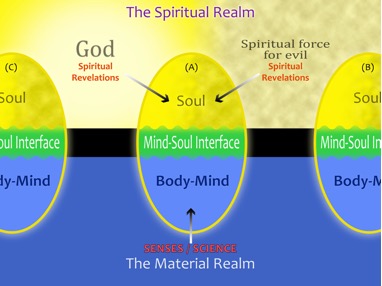
Figure 1. The material realm is the entire physical/physically-derived universe (or multiverse). The spiritual realm exists beyond the material realm and in entirely spiritual in substance. The barrier between the material and spiritual realms is solid except at the mind-soul interfaces of human selves, shown here as A, B and C, who have body-minds in the material realm and souls in the spiritual realm. God and the spiritual force for evil inhabit the spiritual realm. Both influence the human soul, as shown here only for A. A’s body-mind receives information from the material realm, including science, via the senses. For simplicity, the body-mind and soul are given the same sizes. In reality, the body-mind is the physical/physically-derived human self. The soul is the human self’s spiritual component and has no physical scale or location. Original source: Pullin (2014, 91; Figure 1B).
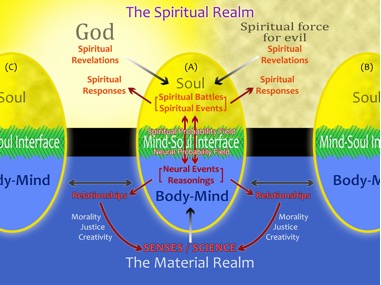
Figure 2. Among three human selves (A, B and C), A is shown as engaged in an episode of Free Thought. A’s body-mind senses and reasons about material realm information. A’s soul receives and processes spiritual information, as revelations from God and/or from the spiritual force for evil. The results of mental reasoning (neural events/reasonings) and soul processing (spiritual battles/events) mix iteratively across A’s mind-soul interface in some common nonmaterial format, here called probability fields, as in quantum probability fields. A’s soul responds in the spiritual realm eliciting more revelations. A’s body-mind responds in the material realm and receives more material realm information. These processes continue, singly or in combinations, and progress through uncertainty, multiple options and temporary resolutions until A brings this episode to a self-chosen end, thereby establishing new baselines in body-mind and soul until the next episode. Morality, justice and creativity are shown here only in the material realm, but are also present in God and human souls. Based on the terminology and processes presented here, human consciousness is the totality of the human self’s neural events and reasonings in the body-mind and spiritual events and battles in the soul. Original source: Pullin (2014, 93: Figure IF).
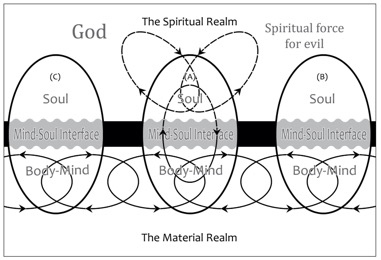
Figure 3. The mechanisms of Free Thought are summarized for person A, among three persons (A, B and C), as three types of interlinked questioning and answering cycles. Information flows within the material realm are depicted as solid lines and those within the spiritual realm as dashed lines. This open system resembles a gear box for transmission of information within and between the material and spiritual realms. Original source: Roger Pullin (2014, 93; Figure 2).
During Free Thought, the body-mind and soul receive information from the material and spiritual realms, respectively, for mental reasoning and soul processing. The results can mix across the self’s mind-soul interface in some common format. Body-mind and soul respond in their respective realms, with further exchanges, processing and mixing.
A Free Thought episode begins with a question, posed by God and/or the spiritual force for evil and/or the self, about some aspect of the self’s positions on a higher thing of life, including beliefs, creativity, ethics, justice, morality and all matters of conscience. When the initial question is posed and throughout the episode, mathematical menus of possible answers and their probabilities are generated.
The episode progresses through iterative cycles of uncertainty, multiple options and stepwise resolutions to a self-chosen outcome - a baseline for the time being, which drives the self’s behavior pending further episodes. It is assumed that the writ of mathematics runs in the material realm and the spiritual realm and that the human self can turn multiple mathematical options, in body-mind and soul, into Free Thought outcomes, after combined mental reasoning and soul processing.
Henry Margenau emphasized that quantum probability fields “carry neither matter nor energy” and are “abstract, immaterial, quite different in essence from electromagnetic and other kinds of field (Margenau 1984, p.22)”. As Henry Stapp put it: “a quantum state represents probabilities. Probabilities are not matter-like They are mathematical connections that exist outside the actual realities to which they pertain. They involve mind-like computations and evaluations: weights assigned by a mental or mind-like process (Stapp 2011, p.20).
In the proposed model, some common format is required for the combination of mental reasoning about material realm information and soul processing of spiritual realm information. It is suggested that quantum probability fields could provide this common format in mathematical forms. The substance dualistic human self, God, and the spiritual force for evil are all assumed to be acting as quantum observers during Free Thought. The substance dualistic human self is thus a conscious and free-willed choice maker in an unscripted drama of good versus evil, while subject to being helped or harmed in both the material and spiritual realms.
Concerning what he called John Bell’s “Interconnectedness Theorem”, Nick Herbert stated: “After Bell, any serious model of reality has to be either manifestly nonlocal or custom-designed to render the locality/nonlocality distinction meaningless” and “Bell’s theorem requires reality, not phenomena to be superluminally linked…All quantum measurements are made up of quantum jumps…these patterns are bound to be local…(but)…the quanta themselves – the unpredictable alphabet which spells out the words and paragraphs of the world’s phenomena – must be non-locally connected (original author’s emphasis) (Herbert 1985, pp.240-241).”
Herbert explained a “local interaction” thus: “as basic as a punch on the nose…Body A affects Body B locally when it either touches B or touches something else that touches B. A gear train is a typical local mechanism…break the chain by taking out a single gear and the movement cannot continue. Without something there to mediate it, a local interaction cannot cross a gap (original author’s emphasis) Herbert 1985, p.212).”
The proposed model is consistent with Bell’s big picture of nonlocality, as applying throughout the material and spiritual realms. The proposed model also fits Herbert’s local analogy of a gear train, which is an apt description for the human self’s information flows, as in Figure 3 above. It also addresses Clarke’s point concerning a substance dualist’s apparent difficulty of explaining how a spiritual soul could interact with different parts of a brain.
Some Implications for Faith and Religions
The proposed model depicts pathways by which the human self can acquire self-felt experiences of making choices about higher things, based on information from both the material and spiritual realms. These self-felt experiences include being at peace with God and/or one’s fellow humans and natural environment, having chosen well, and pangs of conscience, having chosen badly, and can be seen as a subjective proof of the existence of God and the opposing spiritual force for evil.
The proposed model assumes that God, having created any human soul, allies that soul with a body-mind and interacts thereafter with that soul, which connects with that body-mind through the mind-soul interface. On this basis, no human self can be described as unreached by God. It is surely then God’s prerogative to accept or reject every human soul after the death of her/his body-mind. This challenges the claim of any one religion to be the exclusive path to God.
Polkinghorne envisaged: “a physical world within whose open grain it would be fully conceivable that the God who is that world’s Creator is providentially at work through the input of active information (Polkinghorne 2005, p.36).” In the proposed model, the mind-soul interface provides such an “open grain”. Divine and/or diabolic action in the soul can thereby reach the body-mind and beyond. This mechanism can work if quantum probability fields generated by questions and the choice making that can be applied to them are common to both the material and spiritual realms, together with the all-pervasive writ of mathematics.
Some Implications for Science
The first-person perspective poses problems for science. As Penrose put it: “If it is other than a mere convenience of language that we speak as though there were such an independent ‘self’, then there must be an ingredient missing from our present-day physical understanding. The discovery of such an ingredient would surely profoundly alter our scientific outlook (Penrose 2005, p.36).” Penrose called for a “new physics”, without which: “we shall be stuck within the strait-jacket of an entirely computational physics, or of a computational cum random physics. Within that strait-jacket, there can be no scientific role for intentionality and subjective experience (Penrose 2005, p.420).” In the same vein, Joshua Farris wrote: “The argument is that physicality does not capture the first-person perspective. If in fact this is true, then it seems that the first-person perspective must be reducible to or describable in terms of something different than material objects or material processes. It is describable in terms of something that is substantial, yet not material but immaterial – call this the particularity of consciousness problem for materialism (Farris 2023, pp.24-25).”
The proposed model suggests remedies to these deficiencies of an entirely physical approach to human selfhood by depicting each human self as dualistic in substance and existing in both the material and spiritual realms. Moreover, the necessity of envisaging something non-material in the human self has a long history in science. For example, Joseph Needham hailed “the triumph of mechanistic biology…for its own sphere” but denied “its jurisdiction over other fields” and concluded: “The biochemist and biophysicist…can and must be thorough-going mechanists, but they need not on that account hesitate to say with Sir Thomas Browne ‘Thus there is something in us that cannot be without us and will be after us though indeed it hath no history what it was before us and cannot tell how it entered into us (present author’s emphasis)’(Needham 1926, p.257).” In short, humans are ensouled, but explaining how is beyond science.
In the proposed model, the human self resembles a strange loop (sensu Douglas Hofstadter), with the mind-soul interface as a key loopy attribute at its core. Hofstadter rejected dualism, however, and saw the brain “from cerebrum to cortex to column to cell to cytoplasm to particle” as encompassing “the highest and lowest levels” in the mind and as “animate and inanimate (Hofstadter 2007, p.359).” Hofstadter continued:
“Animate entities are those that, at some level of description, manifest a certain type of loopy pattern, which inevitably starts to take form if a system with the inherent capacity of perpetually filtering the world into discreet categories vigorously expands its repertoire of categories ever more towards the abstract. This pattern reaches full bloom when there comes to be a deeply entrenched self-representation – a story told by the entity to itself – in which the entity’s ‘I’ plays the starring role, as a unitary causal agent driven by a set of desires. More precisely, an entity is animate to the degree that such a loopy ‘I’ pattern comes into existence, since this pattern is by no means an all-or-nothing affair (Hofstadter 2007, pp.359-360).” For Hofstadter, the human brain works similarly across what the present author calls basic thought and Free Thought.
Science still has a resistance to anything that smacks of dualism. As John Searle put it: “the urge to reductionism and materialism derives from the underlying mistake that if we accept consciousness as having its own real existence, we will somehow be accepting dualism and rejecting the scientific worldview (Searle 1997, p.xii).” Science is censoring itself by trying to explain human selfhood and consciousness as entirely physical and physically-derived. Science will have to look beyond physicalism for fuller explanations and would benefit from wider research into subjective evidence for faith and unbelief, through multiple case studies as used in psychology.
Some Implications for Human Relations
In the proposed model, interpersonal exchanges are depicted as entirely body-mind events and states in the material realm, though influenced from the spiritual realm by behavior based on the outcomes of Free Thought in human selves. The proposed model also indicates the uniqueness and worth of every human self, as a target for divine and diabolic action and as a maker of choices and taker of the consequences.
Substance monism in any form, and especially in forms that deny the existence of the soul, is less likely than substance dualism to lessen us-and-them attitudes and conflicts among those who view their own group identities as paramount and superior to others. Interpersonal empathy and harmony can be bolstered by recognizing that everyone has a soul and a spiritual life. If all are seen by all as under divine and diabolic spiritual influences, it becomes easier to understand good and evil acts and to forgive and make peace concerning the latter.
The proposed model might assist some quests for common ground between substance monists and dualists and between believers and nonbelievers. It depicts every human self as a connection between the material and spiritual realms. It emphasizes that the one whole reality and the all-pervasive writ of mathematics are shared by everyone. All are therefore kinfolk through being made as human selves, functioning by the same mechanisms, and faced with the same need to explore and explain the human condition.
Acknowledgements
The author thanks all who have helped in discussions of the proposed model, especially the late Peter Clarke during its early development, and Aque Atanacio for the artwork.
Roger Pullin
Email: pullin.roger@gmail.com
References
Atmanspacher, H. and Fach, W. (2015), ‘Mind-Matter Correlations in Dual-Aspect Monism According to Pauli and Jung.’ In Beyond Physicalism: Toward Reconciliation of Science and Spirituality, edited by E. F. Kelly, A. Crabtree and P. Marshall, pp.195-226. Lanham MA: Rowman and Littlefield.
Barbour, I. G. (2002), ‘Neuroscience, Artificial Intelligence, and Human Nature: Theological and Philosophical Reflections.’ In Neuroscience and the Person: Scientific Perspectives on Divine Action, edited by R. J. Russell, N. Murphy, T. C. Meyering and M. A. Arbib, pp.249-280. Vatican City State and Berkeley CA: Vatican Observatory Publications and Center for Theology and the Natural Sciences.
Bejan, A. (2009), ‘The Golden Ratio Predicted: Vision, Cognition and Locomotion as a Single Design in Nature.’ International Journal of Design & Nature and Ecodynamics 4: 97-104.
Bohm, D. (2002), Wholeness and the Implicate Order. New York: Routledge Classics.
Brown, W. S. (2009), ‘Resonance and Dissonance – a Response to Malcolm Jeeves.’ Science and Christian Belief 21: 65-71.
Capra, F. (1977), The Tao of Physics. New York: Bantam Books.
Clarke, P.G.H. (2009), ‘Neuroscience and the Soul: A Response to Malcolm Jeeves.’ Science and Christian Belief 21: 61-64.
Clayton, P. (2002), ‘Neuroscience, the Person, and God: an Emergentist Account.’ In Neuroscience and the Person: Scientific Perspectives on Divine Action, edited by R. J. Russell, N. Murphy, T. C. Meyering and M. A. Arbib, pp.181-214. Vatican City State and Berkeley CA: Vatican Observatory Publications and Center for Theology and the Natural Sciences.
Eccles, J. C. (1991), Evolution of the Brain: Creation of the Self. Routledge: London.
Faggin, F. (2024), Irreducible: Consciousness, Life, Computers, and Human Nature. Alresford, Hampshire U.K: Essentia Books/John Hunt Publishing.
Faizal, M., Krauss, L.M., Shabir, A. and Moreno, F. (2025), ‘Consequences of Undecidability in Physics on the Theory of Everything.’ Journal of Holography Applications in Physics 5 (2) Spring 2025:10-21. DOI: 10.22128/jhap.2025.1024.1118
Farris, J.R. (2023), The Creation of Self: A Case for the Soul. Alresford UK: John Hunt Publishing/iff Books.
Graff, G.M. (2025), The Devil Reached Toward the Sky: An Oral History of the Making & Unleashing of the Atomic Bomb. New York: Avid Reader Press.
Herbert, N. (1985), Quantum Reality: Beyond the New Physics. New York: Anchor Books/Doubleday.
Hodson, M. (2025), ‘Eco-Christianity: Modelling New Creation for Discipleship and Mission.’ Faith and Thought October 2025: 38-48.
Hofstadter, D.R. (2007), I Am a Strange Loop. New York: Basic Books.
Javairia, A. and Khan, A.H. (2014), “The Venerability of the Soul in Islamic Psychology.’ In The Concept of the Soul: Scientific and Religious Perspectives, edited by M. Fuller, pp.121-126. Newcastle-upon-Tyne UK: Cambridge Scholars Publishing.
Jeeves, M. (2009a), ‘Psychologising and Neurologising About Religion: Facts, Fallacies and the Future.’ Science and Christian Belief 21: 25-54.
Jeeves, M. (2009b), ‘Psychology, Neuroscience, Religion and Theology – Pruning the ‘Isms’ and Defining the Conceptual Network.’ Science and Christian Belief 21:72-78.
Jeeves, M. (2013), Minds, Brains, Souls and Gods: A Conversation on Faith, Psychology and Neuroscience. Downers Grove IL: IVP Academic.
Judge, S.J. (2010), ‘Nothing But a Pack of Neurons?’ Faraday Paper No. 16. Cambridge UK: The Faraday Institute for Science and Religion.
Kuhn, R. L. and Murphy, N. (2024), ‘Do Humans Need Souls?’ Opening Statements. Closer to Truth. Youtube, November 4, 2024.
Lavazza, A., Robinson, H (2014), Contemporary Dualism. A Defense. New York: Routledge.
Libet, B. (1999), ‘Do We Have Free Will?’. Journal of Consciousness Studies 6 (8-9): 47-57.
Margenau, H. (1984), The Miracle of Existence. Woodbridge CT: Ox Bow Press.
Murphy, N. (1998), ‘Nonreductive Physicalism: Philosophical Issues.’ In Whatever Happened to the Soul? Scientific and Theological Portraits of Human Nature, edited by W. S. Brown, N. Murphy and H. N.Malony, pp.127-148. Minneapolis MN: Fortress Press.
Murphy, N. (2014), ‘Mind, Soul and the Cognitive Neurosciences.’ In The Concept of the Soul: Scientific and Religious Perspectives, edited by M. Fuller, pp.39-54. Newcastle-upon-Tyne, UK: Cambridge Scholars Publishing.
Needham, J. (1926), ‘Mechanistic Biology and the Religious Consciousness.’ In Science Religion and Reality, edited by J. Needham, pp.219-257. London: The Sheldon Press. Needham cited Sir Thomas Browne’s Religio Medici. 1643. First Part; Section 35: available at: http://penelope.uchicago.edu/relmed/relmed.html
Peacocke, A. (2002), ‘The Sound of Sheer Silence: How Does God Communicate with Humanity?’ In Neuroscience and the Person: Scientific Perspectives on Divine Action, edited by R. J. Russell, N. Murphy, T. C. Meyering and M. A. Arbib, pp.215-247. Vatican City State and Berkeley CA: Vatican Observatory Publications and Center for Theology and the Natural Sciences.
Penrose, R. (2004), The Road to Reality: A Complete Guide to the Laws of the Universe. New York: Vintage Books.
Penrose, R. (2005), Shadows of the Mind: A Search for the Missing Science of Consciousness. London: Vintage Books.
Penrose, R. (2025), ‘What Is Reality?’ In The Nature of Reality: How Mathematics, Physics and Consciousness Combine to Define Our World, edited by R. Webb, pp.6-11. London: New Scientist Essential Guides No. 1.
Polkinghorne, J. (1996), The Faith of a Physicist: Reflections of a Bottom-Up Thinker. Minneapolis MN: Fortress Press.
Polkinghorne, J. (1999), ‘The Laws of Nature and the Laws of Physics.’ In Quantum Cosmology and the Laws of Nature, edited by R. J. Russell, N. Murphy and C.J. Isham, Second Edition, pp. 429-422. Vatican City State and Berkley CA: Vatican Observatory Publications and Center for Theology and the Natural Sciences.
Polkinghorne, J. (2005), Exploring Reality: The Intertwining of Science and Religion. New Haven CT: Yale University Press.
Popper, K. and Eccles, J.C. (1986), The Self and its Brain: An Argument for Interactionism. London and New York: Routledge.
Pullin, R.S.V. (2014), Free Thought, Faith and Science: Finding Unity Through Seeking Truth. Parker CO: Outskirts Press.
Ritchie, S. L. (2019), Divine Action and the Human Mind. Cambridge UK: Cambridge University Press.
Rovelli, C. (2014), Reality Is Not What It Seems: The Journey to Quantum Gravity. U.K: Penguin Random House.
Scott Smith, R. (2012), ‘Could We Know Reality, Given Physicalism? Nancey Murphy’s Views as a Test Case.’ Perspectives on Science and Christian Faith 64 (3): 179-189.
Stubenberg, L. and Wishon, D. (2023), ‘Neutral Monism.’ In The Stanford Encyclopedia of Philosophy (Spring 2023 Edition), edited by E. N. Zalta and U. Nodelman. http://plato.stanford.edu/archives/spr2023/entries/neutral-monism.
Stapp, H. (2011), ‘Quantum Reality and Mind.’ In Quantum Physics of Consciousness, edited by S. Kak, pp.1-118. Cambridge MA: Cosmology Science Publishers.
Turl, J. (2010), ‘Substance Dualism or Body-Soul Duality.’ Science and Christian Belief 22 (1): 57-80.
Ward, K. (1998), In Defence of the Soul. Oxford: Oneworld Publications.
Watts, F. (2009), ‘Psychology, Religion & Theology – a Response to Malcolm Jeeves.’ Science and Christian Belief 21: 55-60.
Wegner, D. M. (2002), The Illusion of Conscious Will. Cambridge MA: A Bradford Book, the MIT Press.
Wigner, E.P. (1960), ‘The Unreasonable Effectiveness of Mathematics.’ Communications on Pure and Applied Mathematics. 13 (1): 1–14.
Wilczek, F. (2021), Fundamentals: Ten Keys to Reality. U.K.: Allen Lane/Penguin Random House.